In this article
If your business operates out of fast-paced commercial hubs like Delhi NCR, Bengaluru, Mumbai, or Hyderabad, you know the frustration: an essential team member resigns, giving you a ticking clock to source, interview, evaluate, and onboard a replacement before team productivity grinds to a halt.
You post an open position on popular job boards. Within 48 hours, you have over 500 applications. But after spending your weekend filtering through resumes, you find that 90% lack the required qualifications, three shortlisted candidates decline the initial screening interview, and the one person you extend an offer to backs out on Day 85 of their notice period after securing a 30% counter-offer elsewhere.
This exhausting, high-friction cycle is the hallmark of traditional recruitment.
When an organization is in its infancy, reactive hiring is standard practice. But as a business expands, treating hiring as an emergency transaction creates operational friction, strains managerial resources, and inflates overhead. To scale predictably, growing organizations must pivot toward strategic talent acquisition.
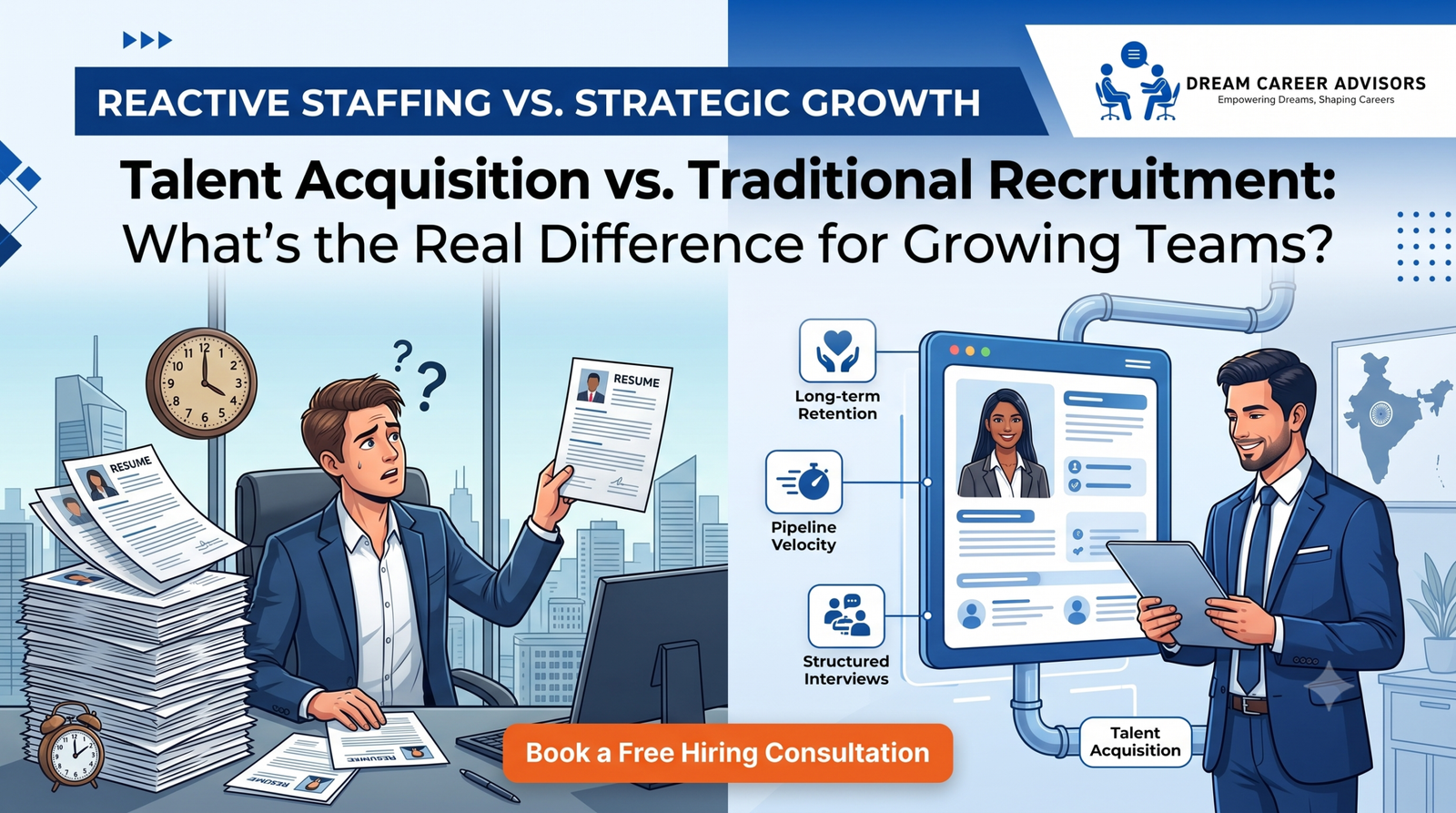
While hiring managers and business owners frequently use these terms interchangeably, understanding the practical distinctions between the two is vital for building a resilient, high-performing workforce.
1. The Core Breakdown: Reactive Replacement vs. Predictive Architecture
At a strategic level, the difference comes down to timeline, approach, and intent.
- Traditional Recruitment is a tactical, short-term transaction. It operates on an ad-hoc, vacancy-driven model. A role opens up due to turnover or immediate project demands, a job description is published, and recruiters race to fill that seat as quickly as possible. Once the candidate signs the offer letter, the task is marked complete.
- Strategic Talent Acquisition is an ongoing organizational strategy. It views talent not as temporary inventory, but as core business infrastructure. A talent acquisition strategy forecasts headcount requirements 6, 12, or 24 months in advance, analyzes market salary movements, builds relationships with passive talent, and ensures every key hire directly advances corporate milestones.
| Operational Dimension | Traditional Recruitment | Strategic Talent Acquisition |
| Operational Trigger | Reactive (begins only after a vacancy occurs) | Proactive (anticipates growth and capability gaps) |
| Core Metric | Time-to-Fill and initial Cost-per-Hire | Quality-of-Hire, Retention, and Ramp-Up Speed |
| Target Audience | Active job seekers checking job boards | High-performing passive candidates and niche talent |
| Evaluation Focus | Keyword matching to an immediate job description | Cultural fit, growth potential, and cross-functional leadership |
| Candidate Journey | Fragmented, transactional interview loops | Nurtured, structured, and relationship-driven communication |
| Long-Term Outcome | Empty seat filled today | Sustainable, pre-vetted talent pipelines for tomorrow |
2. Why Traditional Recruitment Breaks Down in Metro Markets
In major metropolitan business centers across India, relying purely on traditional recruitment frequently leaves fast-growing companies shorthanded. The problem is structural, driven by three persistent market dynamics:
The 60-to-90-Day Notice Period Bottleneck
India’s metropolitan labor market features some of the longest notice periods globally. Under a reactive hiring model:
- An employee submits their resignation on Day 1.
- The internal team spends 20 to 30 days sourcing, screening, and completing interview rounds.
- The selected candidate must serve a mandatory 60-to-90-day notice period at their current employer.
- Your team operates shorthanded for three to four months.
If that candidate drops out or renegotiates during their final week of notice—a common issue across metro technology, finance, and corporate operations—the entire recruitment cycle resets to zero. Traditional recruitment lacks an active backup plan. In contrast, talent acquisition strategies maintain continuously engaged, warm talent pipelines, allowing businesses to activate pre-vetted candidates without starting from scratch.
The Volume vs. Quality Paradox
Publishing an opening in urban centers yields massive application volumes with very low relevance. A general listing in Delhi NCR or Bengaluru often attracts hundreds of mismatched resumes within 24 hours.
Internal HR personnel spend valuable work hours manually sifting through low-relevance applications rather than engaging top-tier contributors. Traditional recruitment is limited to whoever happens to apply; talent acquisition actively targets the top 85% of professionals who aren’t reading job boards because they are currently thriving in their positions.
Short-Term Fit vs. High First-Year Attrition
Transactional recruiters evaluate candidates primarily against narrow, immediate task requirements: “Can this candidate answer calls or balance ledgers right now?”
They rarely evaluate whether the candidate’s career goals align with the organization’s multi-year trajectory, nor do they conduct comprehensive cultural compatibility assessments. Consequently, new hires often exit within six to nine months, restarting an expensive hiring cycle.
3. The True Cost of a Mis-Hire: Why “Quick” Hiring Is Expensive
When teams face immediate hiring pressure, speed is often prioritized over alignment. However, rushing to fill an empty seat creates significant hidden financial and operational costs.
According to global benchmarking data and corporate analytics across Indian industries, the total cost of a bad hire ranges from 50% to 200% of the employee’s annual Cost to Company (CTC).
Consider the compounding impact when an organization rushes a mid-level specialist on an annual CTC of ₹12,00,000:
Direct Recruitment & Portal Advertising Expenses:     ₹1,50,000
Salary Disbursed During Ramp-Up & Underperformance:    ₹4,00,000
Severance, Administration & Exit Documentation:         ₹1,00,000
Secondary Replacement Search & Re-Onboarding:           ₹1,50,000
-----------------------------------------------------------------
Direct Financial Outlay:                                ₹8,00,000
Beyond the direct balance-sheet losses, the indirect organizational toll is often more severe:
- Depleted Executive Bandwidth: Department heads and team leads spend 15% to 20% of their working hours supervising, correcting errors, and retraining struggling hires instead of driving core revenue.
- Team Fatigue and Burnout: Top-performing team members are forced to shoulder extra workloads to cover operational gaps, creating retention risks among your key contributors.
- Delayed Milestones: Missed delivery timelines, damaged client relationships, and compromised product roadmaps.
Traditional recruitment measures success by how quickly an offer is accepted. Talent acquisition measures success by whether the professional is outperforming expectations and driving measurable value 12 to 18 months later.
4. The 5 Pillars of a Modern Talent Acquisition Strategy
To transition an organization from reactive hiring fire-drills to an orderly, scalable talent engine, build your processes around five operational pillars:
+-----------------------------------------------------------------------+
|                    PREDICTIVE TALENT ARCHITECTURE                     |
+-----------------------------------------------------------------------+
        |                  |                  |                  |
[Workforce Planning] [Employer Brand] [Passive Sourcing] [Structured Vet]
        \                  /                  \                  /
         +----------------+--------------------+----------------+
                                   |
                         [Retention & Analytics]
Pillar 1: Predictive Workforce Planning
Avoid waiting for a formal resignation letter before identifying a hiring requirement. Convene quarterly workforce reviews with departmental managers to evaluate forward-looking benchmarks:
- Are you expanding into a new regional territory or vertical in Q3?
- Will seasonal customer volume require flexible staffing support during high-demand cycles?
- Which specialized technical roles represent single points of operational failure?
Proactive workforce planning provides recruiters with adequate lead time to map competitor landscapes before positions become acute operational emergencies.
Pillar 2: Distinct Employer Value Proposition (EVP)
Top candidates in competitive business districts have multiple concurrent opportunities. Why should a high-performing professional choose your company over a venture-funded unicorn or an established multinational?
Talent acquisition treats candidate attraction with the same rigor as client acquisition. It defines your core Employee Value Proposition: career progression roadmaps, mentorship structures, performance incentives, and day-to-day team culture. Professionals need to clearly see how your organization advances their individual career trajectory.
Pillar 3: Active Passive Sourcing & Talent Mapping
The most impactful professionals are rarely active on job portals. A core pillar of modern talent acquisition is consistent relationship cultivation with passive talent. TA specialists continuously track industry peers, benchmark functional talent pools, and maintain professional dialogues with leading contributors well ahead of formal vacancies.
Pillar 4: Structured, Competency-Based Assessment
Unstructured interviews relying on informal conversations and subjective “gut feelings” introduce unconscious bias and inconsistent hiring quality.
A structured talent acquisition framework incorporates objective evaluation scorecards, practical work-sample assessments, and behavioral interview methods (such as the STAR framework). Every candidate is evaluated consistently against explicit competencies essential for the role.
Pillar 5: Data-Driven Performance Metrics
Advanced talent acquisition frameworks measure long-term metrics that go far beyond transactional recruitment:
- Quality of Hire (QoH): Objective manager appraisals and milestone delivery metrics measured at the 6- and 12-month marks.
- Offer-to-Joining Ratio: The percentage of accepted offers resulting in day-one onboarding, tracked to identify drop-off points during notice periods.
- Pipeline Velocity: The speed at which qualified candidates transition through each interview and assessment phase.
- Source Effectiveness: Tracking which candidate sources (internal referrals, dedicated advisory partners, direct outreach) produce the highest-retaining team members.
5. When Should Your Organization Make the Shift?
Not every business requires an enterprise-level internal talent acquisition framework from day one. An early-stage business with a handful of employees and minimal turnover can successfully handle occasional hires via standard reactive staffing.
However, your organization has outgrown traditional recruitment if you encounter any of the following operational warning signs:
- Senior Leadership is Trapped in Interview Loops: Department heads and executives spend 10+ hours every week interviewing poorly matched candidates.
- Chronic Offer Drop-Offs: Extended offers are frequently declined late in notice periods, creating unpredictable hiring delays.
- High First-Year Turnover: Key functional roles require repeat hiring every 6 to 9 months.
- Growth Roadmaps Are Stalled by Headcount: Business development, expansion plans, or software releases are delayed because your company cannot secure qualified personnel.
- Expanding Into Niche or Global Markets: You are building teams across new regions, seeking specialized job consultancy to restructure teams, or navigating cross-border hiring and international mobility through dedicated overseas placement channels.
6. How Dream Career Advisors Bridges the Strategic Gap
Building an internal, full-cycle talent acquisition infrastructure—complete with dedicated sourcers, brand strategists, screening software, and market intelligence—demands substantial ongoing capital expenditure.
Partnering with an experienced talent consultancy allows scaling businesses to gain the advantages of a mature talent acquisition engine without overhead bloat.
At Dream Career Advisors, we do not treat open requisitions as an automated resume-forwarding exercise. We partner with business leaders as a seamless extension of their operations, combining the speed of agile recruiters with the strategic rigor of modern talent acquisition:
- Cultivated, Pre-Vetted Talent Networks: We maintain active talent pipelines across Information Technology, Finance & Accounting, Sales & Marketing, BPO/Customer Support, Logistics, and Executive Leadership. When your business needs to scale, we activate warm candidate networks immediately.
- Multi-Tiered Technical & Cultural Screening: Candidates undergo structured vetting for domain competence, communication standards, and long-term organizational compatibility. Hiring managers only spend time interviewing the top 5% of vetted applicants.
- Notice Period Engagement & Risk Mitigation: Our advisors maintain structured, continuous contact with candidates throughout their notice period, proactively monitoring counter-offer risks to ensure dependable joining ratios.
- Comprehensive Workforce Solutions: Whether your organization requires flexible temporary staffing for project surges, specialized full-time recruitment, strategic talent acquisition, or cross-border overseas placement, we tailor each hiring model to your exact expansion targets.
Transform Your Hiring From an Operational Hurdle Into a Growth Engine
Hiring the right professionals is the single highest-leverage investment your company will make. Transitioning from reactive, transactional hiring to proactive talent acquisition protects your bottom line, stabilizes team retention, and unlocks sustainable business growth.
Stop losing managerial hours to mismatched resumes and unpredictable notice-period dropouts.
Ready to build a predictable, high-performing hiring pipeline for your business?
👉 Book a Free Hiring Consultation with Dream Career Advisors Today